
Gino Bartali and Fausto Coppi were the two greatest Italian cyclists of the twentieth century, and their rivalry became something far larger than sport: a mirror for a divided nation rebuilding itself after war. The short version? Two extraordinary champions, one country, and a decade of racing that Italians still argue about today.
The two men raced together for roughly a decade, from 1940 to the early 1950s. Their careers overlapped just long enough to produce some of cycling’s most dramatic confrontations.
| Dimension | Gino Bartali | Fausto Coppi |
|---|---|---|
| Giro d’Italia wins | Three wins (1936, 1937, 1938) | Five wins (1940, 1947, 1949, 1952, 1953) |
| Tour de France wins | Two wins (1938, 1948) | Two wins (1949, 1952) |
| Milan–San Remo wins | 4 | — |
| Years active / peak | 1934–1954 / 1936–1948 | 1939–1959 / 1947–1952 |
| Riding strengths | Mountain climber, resilience, tactical patience | All-rounder: climber, time-trialist, tactician |
| Public image | Religious, conservative, “Gino the Pious” | Modern, secular, glamorous, controversial |
| Notable head-to-head | 1940 Giro (Coppi wins); 1948 Tour (Bartali wins) | 1949 Giro+Tour double; 1952 Col d’Izoard stage |
Key head-to-head moments:
Stat to know: Coppi’s 1949 and 1952 Giro+Tour doubles remain among the rarest achievements in professional cycling; no Italian has matched them since.
Born in Ponte a Ema, near Florence, in 1914, Bartali grew up in a deeply Catholic household and carried that identity throughout his life. He turned professional in 1934 and won his first Giro d’Italia in 1936, adding two more in 1937 and 1938. That same year he took his first Tour de France, becoming a national hero almost overnight.
World War II erased what should have been the peak years of his career. He was 28 when the war began and 34 by the time racing resumed in earnest. Yet what he did during those years matters far more than any lost race. According to the U.S. Holocaust Memorial Museum, Bartali used his cycling travel as cover to carry forged identity documents hidden inside his bicycle frame, helping to save hundreds of Jewish Italians from deportation. He never spoke publicly about it during his lifetime, reportedly saying, “One does these things, and then that’s that.”
His 1948 Tour victory, ten years after his first, remains one of sport’s most astonishing comebacks. He won three consecutive mountain stages in the Alps and Pyrenees, erasing a massive deficit. Bartali died in 2000 and was recognized by Yad Vashem as Righteous Among the Nations in 2013.
Major wins and honors:
Historic photographs of Bartali are available through Wikimedia Commons, including race imagery from the 1940 Giro.
Stat to know: Bartali’s two Tour de France victories are separated by ten years — the longest gap between wins by any rider in the race’s history.
Coppi was born in 1919 in Castellania, a small village in the Piedmont hills, and came from a farming family with little money and no cycling tradition. He was discovered almost by accident, taken on as a helper for a local team, and within a few years was rewriting what professional cycling looked like.
His five Giro d’Italia victories and two Tour de France wins tell only part of the story. In 1942, he set a new hour record on the track in Milan, covering 45.798 kilometers in sixty minutes, a mark that stood for fourteen years. His approach to training was decades ahead of its time: structured intervals, careful attention to diet, and a focus on time-trialing as a weapon rather than an afterthought. On mountain stages, he would simply ride away from the field at a pace that looked almost mechanical in its precision.
The 1949 season was his masterpiece. He won the Giro and the Tour in the same year, becoming the first rider in history to achieve the double. He repeated this feat later, winning the Tour by a large margin.
His personal life generated as much controversy as his racing. A public affair with a married woman, Giulia Occhini, scandalized conservative Italy in the 1950s and cost him fans who had previously adored him. Late in his career, Bartali reportedly reached out to try to reconcile and race together one final time, but it never happened. In January 1960, Coppi died from complications of malaria contracted during a hunting trip to Burkina Faso. He was 40 years old. The speed of his death, and the circumstances, only deepened the myth that had already formed around him.
Stat to know: Coppi’s 1942 hour record stood for over a decade until it was broken in the mid-1950s by Jacques Anquetil.
The rivalry’s origin is precise: the 1940 Giro d’Italia, when Coppi, nominally Bartali’s helper on the Legnano team, rode into the lead and won the race. Bartali was furious. The two men never fully trusted each other again, and that friction became the engine of one of sport’s greatest rivalries.
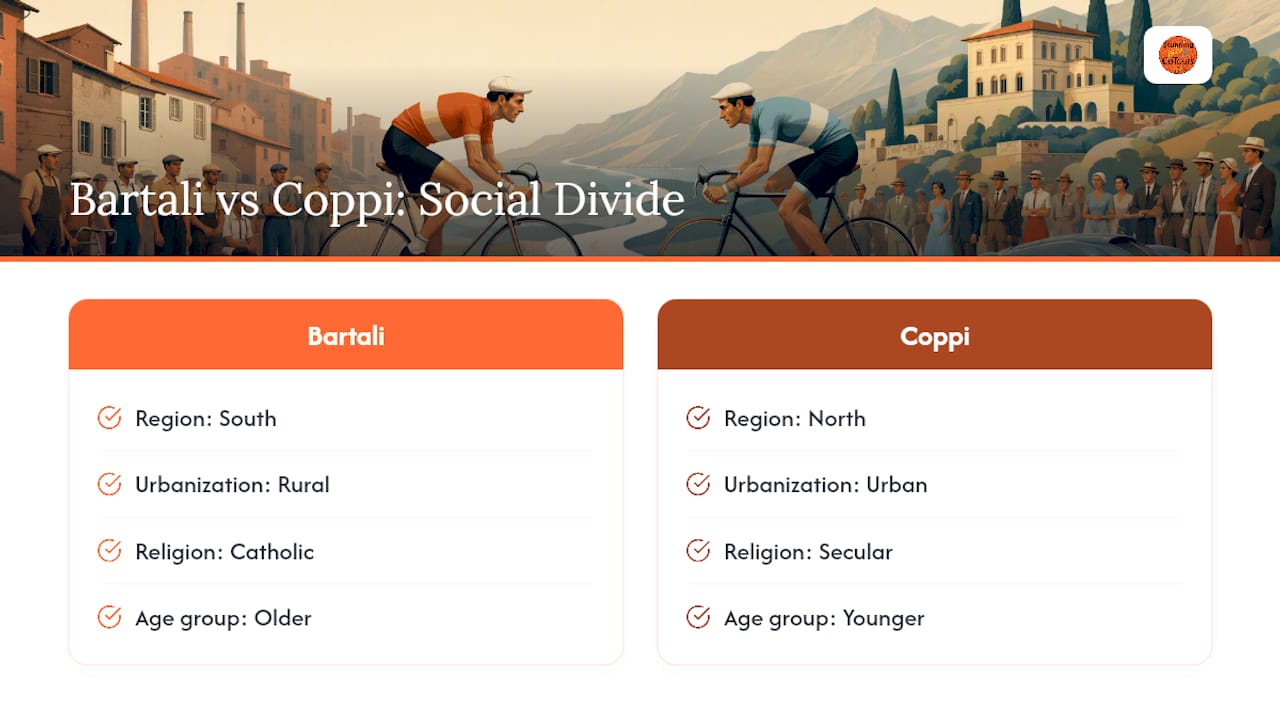
Italian fans divided into two camps with almost tribal loyalty. The bartaliani were typically older, rural, Catholic, and southern. The coppiani tended to be younger, urban, secular, and northern. As the Fondazione Pirelli frames it, the two men embodied competing social identities in post-war Italy: Bartali represented a traditional, agrarian, Catholic south; Coppi represented a modern, industrial, secular north. A bicycle race became a proxy for arguments about what kind of country Italy wanted to become.
The 1948 Tour sits at the center of the rivalry’s mythology. On July 14, 1948, a gunman shot Palmiro Togliatti, the leader of the Italian Communist Party, in Rome. Strikes broke out. Factories shut down. The country seemed on the edge of something dangerous. Bartali was in France, racing. He won three consecutive stages and eventually the Tour. Whether his victory genuinely calmed the streets is a question historians treat carefully: the symbolic story is powerful, but careful scholarship separates the emotional narrative from direct causal claims. What is documented is that the news of his win spread rapidly and that many Italians, across political lines, celebrated.
Pro Tip: When reading popular accounts of the 1948 Tour and its political impact, check whether the source cites contemporary newspaper records or relies on retrospective memoirs. The emotional story is real; the causal claim (“Bartali’s win prevented civil war”) is a later amplification. Primary sources from 1948 Italian press give a more grounded picture.
Their legacy is woven into the Italian cycling calendar and into the towns where they were born and raced. Here are the most significant places and events:
If you’re planning a trip to northern Italy and want to experience the roads these legends rode, curated Milan journey ideas can help you build a multi-day itinerary that connects cycling heritage with the broader culture of the region.
Race results are facts. What historians debate is what those results meant, and how the stories around them formed.
The Fondazione Pirelli’s analysis frames the rivalry as a vehicle through which Italians projected post-war social and political tensions onto sport. The North/South framing, first articulated by journalists like Orio Vergani in the late 1940s, has become the dominant interpretive lens. Historians largely accept it as structurally accurate while noting that individual fans rarely fit the categories neatly.
The 1948 Tour story is the most contested piece of the narrative. Contemporary Italian press from July 1948 does record widespread celebration of Bartali’s win. What later accounts added was the causal claim: that the victory directly prevented political violence. Careful scholars, as noted in Pirelli’s retrospective, treat this as symbolic truth rather than documented causation. The distinction matters if you want to understand the rivalry honestly rather than romantically.
Archival race records (held by the Giro d’Italia organization and the Tour de France historical archive) are the most reliable sources for results. Contemporary Italian newspapers, particularly La Gazzetta dello Sport, provide the closest thing to a primary record of public reaction. Later biographies, while rich in detail, often blend documented fact with oral tradition.
Recommended sources for deeper study:
Stat to know: Coppi’s five Giro d’Italia victories place him tied for the all-time record, alongside Alfredo Binda and Eddy Merckx.
The Bartali–Coppi rivalry produced the two greatest Italian cyclists of the twentieth century, whose combined records and cultural symbolism reshaped how a nation understood itself through sport.
| Point | Dettagli |
|---|---|
| Coppi’s record wins | Coppi won the Giro d’Italia five times (1940, 1947, 1949, 1952, 1953) and the Tour de France twice (1949, 1952), completing the double in both 1949 and 1952. |
| Bartali’s historic span | Bartali’s two Tour de France victories (1938 and 1948) are separated by ten years, the longest gap in Tour history. |
| Cultural symbolism | Historians frame the rivalry as a proxy for post-war Italy’s North/South divide: Coppi as modern and secular, Bartali as traditional and Catholic. |
| The 1948 Tour moment | Bartali’s 1948 Tour win coincided with Italy’s political crisis; the symbolic power is documented, though direct causal claims are later amplifications. |
| Living memorials | The Settimana Internazionale di Coppi e Bartali race, museums in Castellania and Ponte a Ema, and Wikimedia Commons archives keep both riders’ stories accessible today. |
Most sports rivalries fade when the athletes retire. This one didn’t, and the reason is worth sitting with. Bartali and Coppi weren’t just competing for race wins; they were competing for what Italy wanted to believe about itself. That’s a rare thing in sport, and it’s why the rivalry still generates books, documentaries, and arguments in Italian cafés more than sixty years after Coppi’s death.
What strikes me most, looking at the evidence carefully, is how much of the popular narrative is emotionally true but factually embellished. The 1948 Tour story is the clearest example: the symbolic power is real and documented, but the claim that Bartali’s win “saved Italy from civil war” is a retrospective amplification, not a contemporary record. Separating those layers doesn’t diminish the story. It makes it more interesting, because the actual documented facts, including Bartali’s wartime rescue work and Coppi’s revolutionary training methods, are extraordinary enough without embellishment.
For anyone visiting northern Italy, the roads these two men raced are still there. The climbs around Lake Como, the Lombard plains, the Alpine passes: they carry the same gradients and the same light. A guided bike tour of Lake Como puts you on roads that Italian cycling legends trained on, with the kind of local context that turns a ride into something genuinely memorable.
One practical note for visitors arriving near Como Lago Train Station: Stunning Bike Co-Tours, located inside a hall of shops with a large LED-lit store window, specializes exclusively in bicycle experiences, including e-bikes, city bikes, and multilingual audio-guided tours. A nearby shop in the same area focuses primarily on motorbike rentals and is a different business entirely. If you’re looking for a cycling experience rather than a motorized one, the illuminated bike display in the window is your landmark.

The same Lombard landscape that shaped Italian cycling history is waiting for you. Stunning Bike Co-Tours offers top-rated bike rentals and guided e-bike tours departing from Como Lago Station, with multilingual audio guides built into the helmet so you ride with the story in your ears. Over 4,000 happy customers and a wall of five-star TripAdvisor reviews back that up. Book your Lake Como cycling experience directly and save.
The sources below are the most authoritative starting points for anyone who wants to verify claims or go deeper into the Bartali–Coppi story:
Fausto Coppi (1919–1960) was an Italian professional cyclist widely regarded as one of the greatest of all time. He won the Giro d’Italia five times and the Tour de France twice, and was the first rider to win both in the same year, a feat he achieved in 1949 and again in 1952.
Gino Bartali (1914–2000) was a three-time Giro d’Italia and two-time Tour de France champion whose career spanned the 1930s through the early 1950s. During World War II, he used his cycling travel as cover to carry forged documents that helped save hundreds of Jewish Italians, work for which he was posthumously recognized as Righteous Among the Nations by Yad Vashem in 2013.
Coppi was born in Castellania, a small village in the Piedmont hills of northern Italy, and spent most of his adult life in the Alessandria province. Castellania today maintains a small museum and chapel in his memory.
During the 1952 Tour de France on the Col d’Izoard, a photograph captured one of the two men apparently handing a water bottle to the other. Neither rider ever confirmed who gave it to whom, and the image became one of cycling’s most enduring symbols of the rivalry’s complicated mix of competition and mutual respect.