


Most e-bike models advertise a total payload between roughly 220 and 300 pounds, with cargo and heavy-duty models rated 400 pounds or higher. That number is usually the combined weight of rider, gear, and accessories, not the rider alone. The immediate move: find “maximum payload” on the specific model’s spec sheet, then subtract the bike’s net weight and your expected gear to see what’s actually left for you.
TL;DR:
- Always verify whether the maximum payload includes the bike weight or just rider and gear to avoid overloading your e-bike.
- Wheel ratings, spoke count, and rack limits are often more critical failure points than frame material when carrying heavy loads.
- Testing a loaded bike on real terrain before purchase provides the most accurate assessment of handling, braking, and range for heavier riders.
- Heavier riders should aim for models with at least 180mm rotor brakes and higher spoke counts to ensure safety under increased weight.
- Confirm all manufacturer specifications in writing, especially payload definitions and wheel ratings, to prevent warranty disputes and miscalculations.
The e-bike weight limit swings widely depending on how the bike is built and what job it’s designed for. A folding commuter and a cargo hauler are engineered around completely different stress loads, and their ratings reflect that.
Here’s how the ranges typically break down across categories, based on brand compilations and manufacturer specifications compiled across the industry:
The gap between a folding bike and a cargo bike comes down to structural choices most riders never think to check: frame tubing gauge, wheel and rim rating, spoke count, and how the rear rack is engineered. A cargo bike’s longer wheelbase and reinforced rear triangle distribute load across more contact points, which is why it can carry nearly double what a commuter model handles.
Brands are inconsistent about how they define these numbers, and that inconsistency is the single biggest source of confusion for shoppers. Treat every range above as a shopping benchmark, not a guarantee. Model-specific spec pages from brands like Lectric list figures anywhere from 275 to 400 lb depending on the exact configuration, which is why the individual product page always overrides a general category rule.
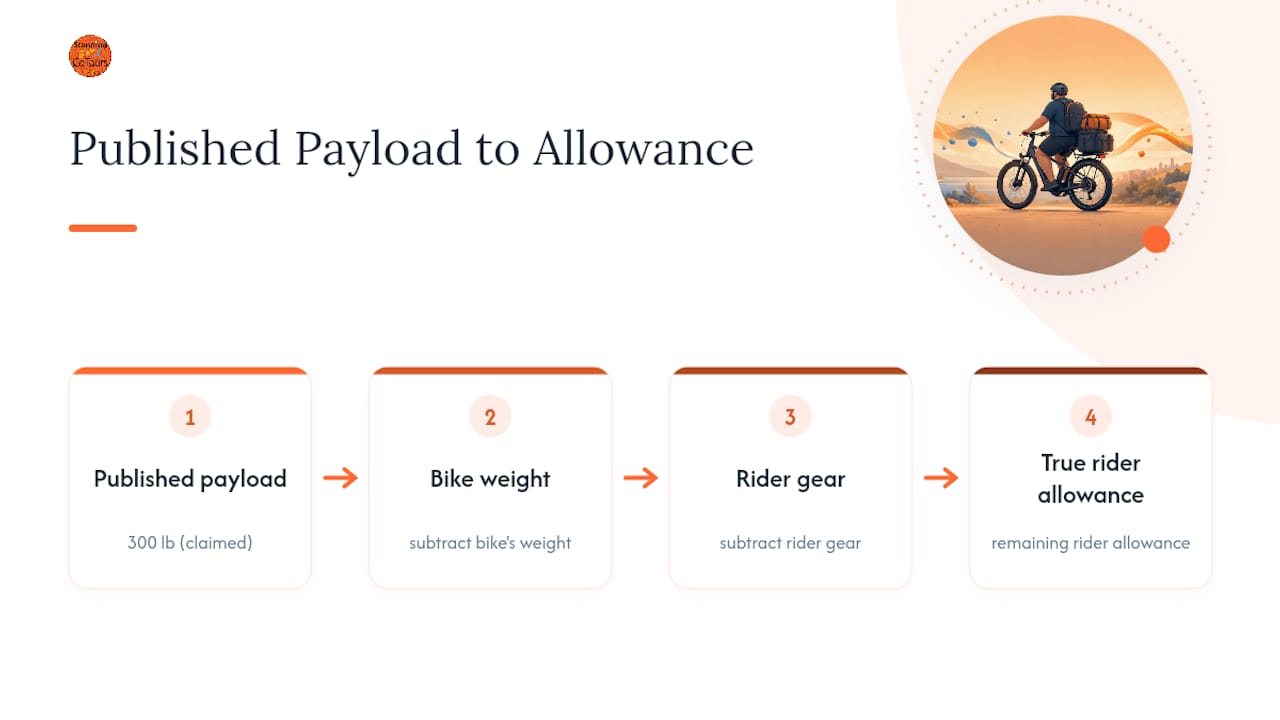
Three terms get mixed up constantly, and untangling them is the whole game. Maximum payload is the total weight the bike is engineered to carry safely, which on most models includes the rider, clothing, bags, and any cargo. Net bike weight is just the bike itself, empty. Some manufacturers use a GVWR-style figure (gross vehicle weight rating) that bundles bike weight and payload into one ceiling, borrowing the term from the automotive world.
Here’s the math that actually matters:
A worked example: a light commuter e-bike weighs 45 lb and lists a 300 lb total payload. That leaves 255 lb for rider and gear. A midweight e-bike weighs 65 lb with a 350 lb total payload, leaving 285 lb. Two bikes with similar published numbers can hand you a 30 lb swing in real rider capacity, depending purely on how much the bike itself weighs.
Pro Tip: If a listing doesn’t specify whether payload includes the bike’s own weight, email or call the seller and ask for it in writing. A verbal “should be fine” from a salesperson isn’t something you can act on if a warranty claim ever comes into question.
Weight doesn’t just sit there. It changes how the bike stops, turns, and how far a single charge takes you.
A useful planning number is roughly 20 Wh per mile under typical flat-terrain conditions, but range calculators show that added rider weight and climbing terrain push consumption noticeably higher, sometimes cutting real-world range by a meaningful percentage compared to the flat, lighter-rider scenario used in marketing claims.
On hilly routes, rider weight often becomes the single biggest factor in battery drain after assist level, more influential than tire pressure or wind. If you’re riding on a route with real elevation change, size your battery expectations accordingly rather than trusting a flat-terrain range figure. Riders who consistently operate near their bike’s limit should also inspect spoke tension and brake pad wear more frequently than the manual’s default schedule suggests, since safety research on electric bicycles points to component fatigue as a recurring risk factor when vehicles run near or beyond rated capacity.
Spec sheets bury the numbers that matter most among marketing language. Here’s the order to check them in:
Once you’ve narrowed candidates on paper, test them loaded. A short loop with your actual expected weight tells you more in ten minutes than any spec sheet will. Try a full stop from riding speed, and if there’s any incline nearby, a hill start with your gear loaded on.
Adaptive and specialty rental options exist for exactly this kind of situation, where extra stability matters more than shaving pounds off the frame.*
A few specific questions separate a confident purchase from a guessing game. Ask the seller directly whether the published maximum payload is total weight or rider-only, and get the bike’s net weight in writing. Ask about the rack’s separate passenger or cargo limit if you plan to carry anything beyond your own body weight. Ask what tire pressure they recommend for heavier loads, since underinflated tires flex more and wear faster under extra mass.
Push for a written reply by email rather than a verbal answer at the counter. Written confirmation is what you’ll want if a warranty question ever comes up.
Walk away if a seller can’t produce wheel or rim ratings, gives you a vague “it should hold anyone” answer, or the manual has no overload language at all. Those are the same gaps that turn a reasonable-looking bike into a warranty dispute six months later.
Every rental at Stunning Bike Co-Tours starts with an equipment check and a straightforward conversation about rider weight, so we can recommend the right frame and battery size before you ever swing a leg over the saddle. With over 4,000 riders through our doors and multilingual audio-guided tours built into the experience, we’ve learned that a loaded test ride around Como reveals handling quirks no spec sheet mentions, from brake feel on the lakeside descents to how a battery actually performs on Como’s inclines.

The conventional advice on e-bike weight limits treats the published number as the whole answer, and that’s where most guidance falls short. A “300 lb capacity” claim means almost nothing until you know whether it includes the bike itself and whether your gear pushes you past what’s actually left over. The math in this guide isn’t a nice add-on to spec-sheet reading; it’s the actual skill that turns a marketing number into a decision you can trust.
What’s overrated in most buying guides is frame material. Aluminum versus steel gets endless attention, while wheel rating and spoke count, the parts that fail first under sustained overload, get a single line if they’re mentioned at all. If you’re shopping near the upper end of any category, spend your attention on wheels and brakes before you worry about the frame.
The most practical thing a heavier rider can do before committing to a purchase is ride the bike loaded, on real terrain, before money changes hands. Specs tell you what an engineer promised. A loaded ride tells you what’s true.
— Andrea
Buying an e-bike sight unseen, based purely on a spec sheet, is a real gamble when your weight is anywhere near a model’s rated capacity. Renting first lets you feel how a bike handles loaded, how the brakes respond on an actual descent, and how far the battery really takes you, all before you commit to a purchase. Stunning Bike Co-Tours makes that test simple: our fleet gets inspected before every ride, our staff can talk you through the right bike size for your weight and route, and every guided tour includes multilingual audio guidance so you’re learning about Lake Como while you’re learning about the bike.

Look for our large window lit up with an LED bike display inside the shop hall. We’re tucked just off the street rather than facing it directly, so it’s worth glancing past the storefronts near Como Lago Station rather than assuming the first rental counter you spot is us. Book a guided tour or self-guided rental to put a real e-bike under real load before you decide what to buy, or browse our full rental options in Lake Como to check availability for your dates.
For deeper technical detail beyond this guide, BikeTips’ brand-by-brand payload compilation is useful for comparing specific models. VoltCalcs’ range calculator lets you plug in your own weight and terrain for a personalized estimate. TRANSNET’s safety and policy research covers the broader risk landscape behind overload warnings.
Yes. Many standard and fat-tire e-bikes list total payload capacities of 300 lb or higher, though you should confirm whether that figure is rider-only or includes gear before assuming you fit within it.
Yes, but options narrow to fat-tire, heavy-duty, and cargo e-bikes specifically rated for 400 lb or more total payload. Calculate your rider-plus-gear allowance carefully, since many standard commuter models fall well short of this range.
There’s no single cutoff. “Too heavy” means your calculated rider-plus-gear total exceeds the specific model’s published maximum payload after subtracting the bike’s own net weight.
Yes, as long as the chosen model’s maximum payload, wheel rating, and rack limit (if applicable) comfortably cover that rider’s total weight plus gear, ideally with a small safety margin left over.
Check the manufacturer’s spec sheet or manual for the maximum payload definition, subtract the bike’s net weight if it’s a total figure, and request written confirmation from the seller if anything is unclear. Testing that same load on a rental, such as one from Stunning Bike Co-Tours, confirms the math in the real world.