


For most American travelers heading to Italy, Saily is the best overall eSIM pick thanks to low starting prices and flexible data sizes up to 20 GB, while Jetpac wins on pure value with plans like 20 GB for around $17. If you’d rather not think about data at all, Holafly’s unlimited plans remove the math entirely, and if you want to make calls or send texts on an Italian number, Orange Holiday Europe bundles voice and SMS with data in a way most pure-data eSIMs don’t.
Every one of these options installs digitally before you ever set foot on a plane, so there’s no kiosk line at Malpensa and no hunting for a SIM card shop once you land near Lake Como. Expect capped data plans (1 GB to 20 GB) to run roughly $4 to $20, while unlimited plans typically cost several tens of dollars for a week or two of travel, according to Holafly’s Italy pricing page.
Quick stat: Saily’s Italy plans start near $3.99, while Airalo’s entry-level Italy packages begin around $4, putting the cheapest usable data plans within a few dollars of each other across the top providers.
The best eSIM for Italy depends on your priorities: Saily wins on flexible pricing, Jetpac on value per gigabyte, and Holafly on worry-free unlimited data.
| Point | Details |
|---|---|
| Buy before you fly | Purchase and install your eSIM in the U.S. so it’s ready the moment you land in Italy. |
| Match data to your habits | Budget roughly 1 GB per day for typical use, less for texting-only trips, more for streaming or hotspotting. |
| Choose regional if crossing borders | A regional Europe eSIM avoids extra charges if your trip includes Switzerland, France, or Austria. |
| Check network transparency | Providers that name their Italian carrier partner (TIM, Vodafone, WindTre, Iliad) reduce rural coverage risk. |
| Pair connectivity with local expertise | Stunning Bike Co-Tours complements a working eSIM with audio-helmet tours and onsite Apple device help for American visitors near Lake Como. |
The honest truth about shopping for an Italy eSIM is that most providers are reselling capacity on the same handful of Italian networks. What actually separates them is price structure, data ceilings, and whether they bother to tell you which network you’ll be roaming on. Here’s how the major U.S.-available options stack up.
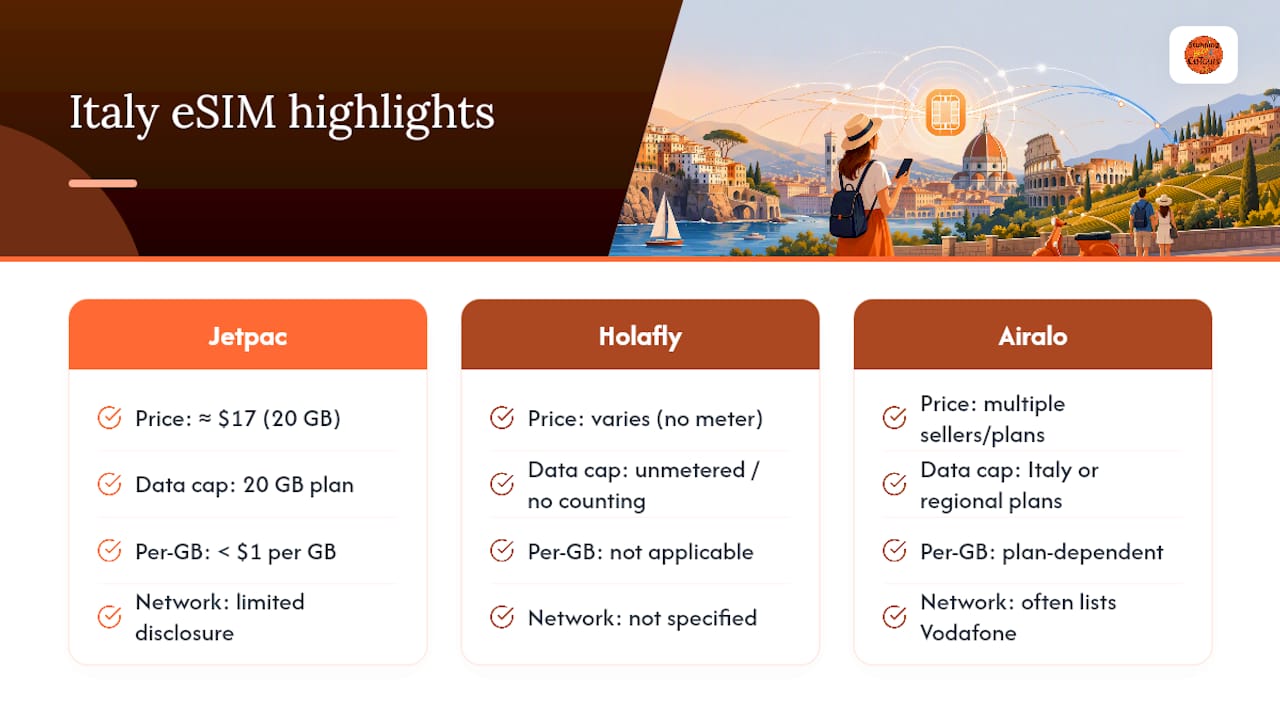
Every provider on this list can be purchased and activated by U.S. customers before departure; none require an Italian address or a local bank account.
A few of these deserve a quick note beyond the table. Saily’s cheapest tier covers light texting and maps use for a long weekend, while its 20 GB option suits a two-week trip with regular photo uploads. Jetpac’s 20 GB for roughly $17 works out to less than a dollar per gigabyte, one of the cheapest rates among mainstream providers. Holafly skips the data-counting entirely, which appeals to travelers who stream navigation and video calls without checking a meter. Airalo functions more like an app store for eSIMs, letting you compare Italy-only and regional Europe plans side by side before you buy, and its Italy page lists which network (often Vodafone) a given plan rides on.
Roamless, ETravelSim, Truely, Breeze, Sim Local, Ubigi, SimOptions, and Nomad round out the field. They show up consistently in Italy eSIM roundups, but most publish limited details about their exact network partners or per-GB pricing, so treat them as secondary options worth comparing against the five above before you commit.
Picking a provider gets easier once you break the field into what each one actually does well. Some optimize for rock-bottom price, others for zero-hassle data, and one or two focus on giving you a working phone number rather than just a data pipe.
Saily built its Italy offering around flexibility. Plans start at $3.99 for a small data package and scale up to 20 GB, with regional Europe bundles starting around $8.99 for travelers adding stops in France or Switzerland. The app activates the plan automatically once you land, which matters if you’d rather not fumble with settings menus in an airport line. It’s best for travelers who want to pay only for the data they’ll actually use.

Holafly takes the opposite approach: unlimited data, no counting, no add-ons mid-trip. Its Italy eSIM page lists 4G and 5G coverage with pricing tiers tied to trip length, typically running higher per day than capped plans but removing any risk of running dry on your last day in Bellagio. The catch with most unlimited eSIM plans, Holafly’s included, is a fair-use policy that can throttle speeds after heavy sustained use, so read the fine print if you’re planning to hotspot a laptop for work.
Jetpac consistently shows up in comparison roundups as the value leader, with a 20 GB plan around $17. That’s a strong ratio for anyone who streams music, navigates constantly, and posts photos without rationing megabytes. It lacks the brand recognition of Airalo or Holafly, but the per-gigabyte math is hard to beat.
Airalo functions as the eSIM marketplace most travelers stumble onto first, and for good reason. Its Italy page offers local, regional, and global plan tiers starting around $4, with the app showing exactly which network each plan primarily uses. That transparency is rarer than it should be in this category. Airalo suits travelers who want to compare several countries’ plans in one app, especially if Italy is one stop on a longer European itinerary.
Orange Holiday Europe (sometimes marketed as Orange Travel) stands apart because it bundles calls and SMS with data, backed by the Orange network’s roaming agreements across Wind Tre and other Italian carriers. If you need to actually call a hotel front desk or receive a verification text from your U.S. bank, this is the category most data-only eSIMs skip entirely.
Roamless gets mentioned in roundups for hotspot-friendly and occasionally voice-capable plans, making it worth a look if tethering a laptop matters more to you than brand recognition. ETravelSim and Breeze show up as additional marketplace alternatives, generally competing on price rather than unique features. Truely is a smaller entrant with niche plan options that some travelers prefer for very short trips. Sim Local offers a dedicated Italy plan-selection page, while Ubigi, SimOptions, and Nomad round out the field as established travel eSIM sellers, though public details on their exact Italy network partners are thinner than what Airalo or Saily disclose.
Pro Tip: If a provider’s website doesn’t name the Italian network it rides on (TIM, Vodafone, WindTre, or Iliad), assume you can’t verify rural coverage in advance. That’s a real gap for a Lake Como trip, where signal quality varies by which side of the lake you’re on.
Start with how much data you’ll actually burn, not how much sounds safe. Light users, mostly texting and occasional maps, get by on roughly 0.4 GB per day. Typical travelers who stream music, use navigation constantly, and post to social media should budget closer to 1 GB per day. Heavy users running video calls or tethering a laptop can hit 2.5 GB or more daily.
Pro Tip: Set the eSIM as your default data line but keep your home carrier’s line active for iMessage and WhatsApp verification. That way, a friend’s text still reaches you even if the eSIM briefly drops signal near the lake.
Run through this checklist before checkout: confirm the phone is unlocked, confirm eSIM support in your device settings, pick Italy-only or regional based on your itinerary, and match the data tier to your actual daily habits rather than a worst-case guess.
Buy and install your eSIM while you’re still in the U.S., ideally a few days before departure, not at the gate. Every major provider sends a QR code or activation link by email immediately after purchase.
Common snags include phones that are still technically carrier-locked, dual-SIM settings that default back to your home line, and eSIMs that take a few minutes to appear after installation. If the eSIM doesn’t show up immediately, restart the phone once. Pre-installing before departure is the single most reliable fix for activation-day headaches, since Wi-Fi at Fiumicino or Malpensa can be spotty exactly when you need it most.
For step-by-step device settings specific to Apple hardware, see this Apple device troubleshooting guide, and for a broader activation walkthrough, Esimglobe’s pre-travel installation guide covers the process across device types.
Coverage promises on a provider’s website mean little until you know which Italian network carries the signal. Most eSIMs route onto TIM, Vodafone, WindTre, or Iliad, and providers willing to name that network upfront, as Airalo does, give you a real way to judge rural performance before you buy.

That distinction matters more around Lake Como than in central Milan or Rome. The lake’s steep hillsides and small towns create pockets where one network holds a strong signal and another drops to a crawl. A provider that discloses multi-operator roaming reduces the odds of finding yourself with full bars in Como town and nothing in Bellagio.
Practical backups for rural stretches:
Pro Tip: Test your eSIM signal the moment you arrive in Como, before you head out on a bike tour. If it’s weak, our team can often help troubleshoot Apple device settings on the spot, right at our storefront.
A working eSIM gets you online. It doesn’t get you oriented, and it definitely doesn’t tell you which lakeside road has the best view of Villa Olmo at golden hour. That’s where a little local expertise fills the gap your data plan can’t.
Stunning Bike Co-Tours has guided more than 4,000 satisfied travelers around Lake Como, many of whom show up with the same eSIM questions you might have right now. Our multilingual audio-helmet tours mean you don’t need a strong data connection to hear route narration, since the guide is built directly into the helmet, not streamed over your cellular plan.
A traveler who lands with a shaky signal shouldn’t also lose the experience. That’s the whole reason our audio guides run through the helmet instead of an app that needs constant bars.
Beyond bikes, we offer onsite Apple device troubleshooting for tourists wrestling with eSIM installation or general iPhone hiccups, plus luggage storage near Como Lago Train Station so you’re not dragging a suitcase while your phone finally connects.
One quick distinction worth making: if you’re comparing us to Como Rental Solutions nearby, know that they primarily rent motorbikes, while we specialize in bikes, e-bikes, and guided tours with a device-support layer they don’t offer.
Refund and modification policies vary sharply across eSIM providers, and this is where reading the fine print before you buy actually pays off. Most eSIMs are digital goods, which means many providers treat an activated plan as non-refundable the moment the QR code is scanned or the plan connects to a network.
The safer window is before activation. Saily and Airalo both allow cancellation or refund requests if the eSIM has never connected to a network, though the exact grace period varies by provider and sometimes by payment method. Holafly’s unlimited plans are typically sold as fixed-duration packages, so shifting your trip by a few days may mean losing value rather than getting an extension, unless you contact support before the plan starts.
If your itinerary changes and you need more data mid-trip, most providers let you top up through the same app rather than forcing a whole new purchase, which is faster than starting over with a different plan tier. The practical rule: buy your eSIM close to your actual departure date rather than weeks in advance, and avoid activating it until you’re within a day or two of landing, so you keep maximum flexibility if flights shift.
Support quality is where the bigger, more established providers separate themselves from the smaller entrants on this list. Saily, Holafly, and Airalo all offer in-app chat support in English, generally responding within a few hours, which matters if your eSIM isn’t activating and you’re standing in a taxi line at Malpensa.
Smaller providers like Roamless, ETravelSim, Truely, and Breeze are harder to vet on support responsiveness since they publish less detail about response times or support hours. That’s not necessarily disqualifying for a short trip, but it’s worth checking a provider’s app store reviews for support complaints before you rely on it as your only connectivity option in a country where you don’t speak the language fluently.
A practical workaround for anyone nervous about support gaps: install and test your eSIM while still in the U.S., where you have Wi-Fi backup and time to troubleshoot with support chat if something’s wrong. Doing this a few days before departure, rather than the morning of your flight, turns a potential emergency into a minor annoyance you can solve calmly from your kitchen table.
The purchase itself takes minutes. Most providers process payment and email a QR code or activation link within five to ten minutes of checkout, sometimes instantly. Installing that eSIM on your phone, scanning the code, and confirming it appears in your cellular settings adds another five minutes for most travelers, longer if you’re troubleshooting a locked device or hunting through unfamiliar settings menus.
The real timeline to plan around isn’t the technical install, it’s when the plan activates. Saily and similar providers often trigger activation automatically once your phone connects to an Italian network on arrival, so the plan itself sits dormant (and doesn’t burn validity days) until you land. Others start the countdown the moment you install the profile, regardless of whether you’ve left home yet. That distinction is worth confirming on the provider’s page before buying, since installing a plan with install-based activation a week early means you could burn several validity days before your flight even boards.
Budget a total of 15 to 20 minutes from purchase to a verified working connection, done from home, well before your departure date.
Most Italy-only eSIM plans stop at the border. If your itinerary includes a day trip into Switzerland from the northern end of Lake Como, or a train ride to France or Austria, a single-country Italy plan will typically show no signal or trigger expensive out-of-plan roaming charges the moment you cross.
This is exactly the scenario where a regional Europe eSIM pays for itself. Providers like Saily and Airalo both sell regional bundles that cover Italy alongside dozens of other European countries under one data allowance, so crossing from Como into Lugano doesn’t require buying a second plan or losing connectivity mid-trip. Orange Holiday Europe also markets itself around this kind of cross-border roaming, given Orange’s broader European network agreements.
If your entire trip stays within Italy, a single-country plan is almost always the cheaper per-GB option, since regional bundles typically charge a premium for that broader coverage. The decision comes down to your actual route: check your itinerary for any day trips or border crossings before assuming an Italy-only plan will follow you across the Swiss or French border without a hitch.
The biggest mistake I see in how this topic gets covered is treating “best eSIM” as a single, universal answer. It isn’t. The right pick depends entirely on whether you’re a texting-and-maps traveler or someone tethering a laptop for work calls from a Bellagio balcony, and most roundup articles gloss over that distinction in favor of a tidy top-three list.
The second overrated factor is brand recognition. Airalo and Holafly get the lion’s share of search traffic, but Jetpac’s per-GB pricing and Saily’s flexible tiers often deliver better value for the exact same coverage, since they’re frequently riding the same Italian networks underneath.
What actually deserves more attention: network transparency. A provider that names its Italian carrier partner is giving you real information about rural performance, not marketing copy. Prioritize that disclosure over a slightly lower headline price, especially if your trip includes lakeside towns rather than just Milan and Rome.
*— Andrea
Once your eSIM is installed and you’ve confirmed a signal, the next question is what to actually do with that connectivity in Como. Stunning Bike Co-Tours turns a working data connection into a full day of exploring the lake’s shoreline, hidden villas, and small-town cafés, without the fatigue of walking the whole route on foot.
Our fleet includes premium e-bikes and city bikes, paired with multilingual audio-helmet guides that work regardless of your phone’s signal strength, plus onsite Apple device troubleshooting if your eSIM needs a second look after arrival. We also offer luggage storage near Como Lago Train Station, useful if you’re testing your connection before checking into a hotel.
Pro Tip: Confirm your eSIM is working before you book your tour time slot, that way you can use turn-by-turn navigation on our self-guided routes without worrying about signal gaps.
Ready to book? Reserve your e-bike tour or rental directly through our site, or browse rental and tour options to find the right fit for your Lake Como itinerary.
Saily offers the best balance of low starting prices and flexible data sizes for most U.S. travelers, while Jetpac delivers the strongest value per gigabyte and Holafly suits anyone who wants unlimited data without tracking usage.
Yes. An eSIM lets you install and test your connection before you leave the U.S., avoiding airport SIM kiosks and letting you navigate, translate, and stay reachable the moment you land.
Airalo is a strong, transparent option that names its network partners, but Saily often beats it on starting price and Jetpac frequently beats it on cost per gigabyte, depending on the exact plan size you need.
Airalo’s app offers the broadest side-by-side plan comparison, while Saily’s app is praised for straightforward, automatic activation on arrival, so the “best” app depends on whether you value comparison shopping or simplicity.
No, but confirm your chosen provider discloses its Italian network partner, since coverage can vary more across Como’s hillside towns than in flatter, denser cities like Milan.