


A hotel guest waiting three hours between checkout and a train usually does best with the concierge desk. A day-tripper, an Airbnb arrival, or anyone landing after the front desk closes needs dedicated luggage storage instead. The real decision comes down to four things: operating hours, cost, security coverage, and whether you’re actually a paying guest. For most Como visitors juggling both a bag and a bike rental, pairing storage with a local activity like a Stunning Bike Co-Tours rental solves the whole problem at once.
TL;DR:
- Dedicated luggage storage near transit points like Como San Giovanni station generally provides clearer pricing, insurance details, and longer hours than hotel concierge services.
- Automated lockers offer 24/7 access and online booking with clear insurance limits, but oversized or irregular items often require staffed stores where staff can assess and accommodate special baggage.
- Hotel concierge storage is usually free for registered guests with short-term needs during desk hours, but non-guests face inconsistent policies and limited security, risking unlabeled, unsecured items.
- Confirm storage policies, including time limits, insurance coverage, and desk hours, at least 24 hours in advance to avoid last-minute complications, especially during peak seasons.
- Pairing luggage storage with bike rentals at a secure location like Stunning Bike Co-Tours transforms idle hours into sightseeing time and is ideal for travelers with tight schedules or multiple stops.
Hotel concierge holding wins on convenience when it works. You walk in, hand over your bag, walk out unencumbered, and never think about it again. Many hotels offer this free to registered guests, and there’s no extra stop on your route through town.
But the arrangement has real limits. Front desks run on staffing schedules, not traveler schedules, and hotel check-in workflows are built around guest turnover, not open-ended storage requests from people passing through. Concierge desks also prioritize registered guests, so non-guests, early arrivals before check-in day, or late checkouts can get turned away, especially during peak lake season.
Dedicated luggage storage flips those trade-offs. You’ll travel to a specific location and pay a fee, but you get published pricing, stated insurance limits, and hours that don’t care what time your train leaves.
Hotel concierge works best for:
Dedicated storage works best for:
Most hotels in Como will hold luggage for registered guests at no charge, typically for a few hours before check-in or after checkout. The catch is that “hold” often means an unlocked storage room or a spot behind the desk, not a secured, insured space.
Non-guests face a coin flip. Some hotels will store a bag for a friend of a guest or a walk-in traveler as a courtesy; plenty won’t, particularly when the lobby is busy with actual check-ins. Concierge services generally exist to support the people staying there, not to function as a public-facing depot.
Desk hours matter more than most travelers expect. If your flight lands at 6 AM or your train leaves at 11 PM, you need to know whether anyone will be at that desk to hand your bag back.
Before you rely on a hotel for storage, do this:
Pro Tip: Call the hotel 24 hours ahead, even if you’re a confirmed guest. Front-desk policies change seasonally, and a phone confirmation beats an assumption every time.
Third-party storage in Como comes in three flavors: staffed shops, automated lockers, and app-based host networks that list local businesses as drop-off points. All three tend to outperform hotel concierge on transparency, even if none of them are free.
Automated lockers in the city advertise round-the-clock access with online booking and QR-code check-in, plus stated insurance limits, some listings quote coverage up to €500 per locker. Marketplace platforms show multiple Como pickup points starting around €1.49 with 24/7 availability across six locations, while others list day rates starting near €3.50 with app-based booking confirmations. A few providers publish rates from about €4.39 a day alongside clearly stated insurance amounts, which is the kind of pricing transparency hotel concierge desks almost never offer.
What you should expect from a solid provider:
Access hours vary by format. Automated lockers run 24/7 by design. Staffed shops post specific hours, often matched to train schedules. Confirm the coverage amount before booking. A €500 cap won’t help much if you’re storing camera equipment worth triple that.
Match the choice to your situation rather than your preference. Five questions settle it almost every time:
Quick scenario check:
Travel-experience guides consistently recommend confirming storage arrangements at least a day ahead rather than assuming availability on arrival, a small step that avoids most last-minute scrambles.
Stunning Bike Co-Tours runs luggage storage near the Como Lago train station, a location most travelers pass through anyway on the way into town or back to the airport. Bags are handled securely on-site, with staff on hand to check items in and out, so you’re not gambling on an unlocked hotel storeroom or guessing whether a locker is actually free.
The bigger advantage is what you do with the hours you’d otherwise spend sitting on a bench. Pair your drop-off with a bike rental and you can ride the lakefront, reach Villa Olmo, or take a guided loop with a multilingual audio guide built into the helmet instead of waiting around. Stunning Bike Co-Tours has served over 4,000 happy customers with five-star reviews on TripAdvisor, backed by well-maintained bikes and staff who know the roads.
Ski bags, musical instruments, oversized suitcases, and stroller sets don’t fit neatly into a standard locker, and that’s worth checking before you show up. Automated lockers have fixed dimensions, usually sized for a large wheeled suitcase, and an oversized item simply won’t close the door.
Staffed shops handle this far better, since a person can assess the item and find shelf space rather than force it into a cube. If you’re traveling with something unusual, a staffed location or a service like Stunning Bike Co-Tours, where a person receives the item directly, beats an automated locker every time.
Hotels face the same limitation in reverse. A back-office storage room might have the floor space for an oversized bag, but many hotels cap what they’ll accept, particularly for anything that blocks a hallway or storage closet during a busy checkout day. Always describe the item’s size and shape when you call ahead, rather than assuming “luggage storage” covers anything you can carry.
For irregular items, insurance coverage also gets trickier. A stated per-locker limit assumes a normal suitcase; a bike case or a set of golf clubs may exceed that declared value, so ask specifically whether the provider’s insurance applies to non-standard items or caps out at a lower rate.
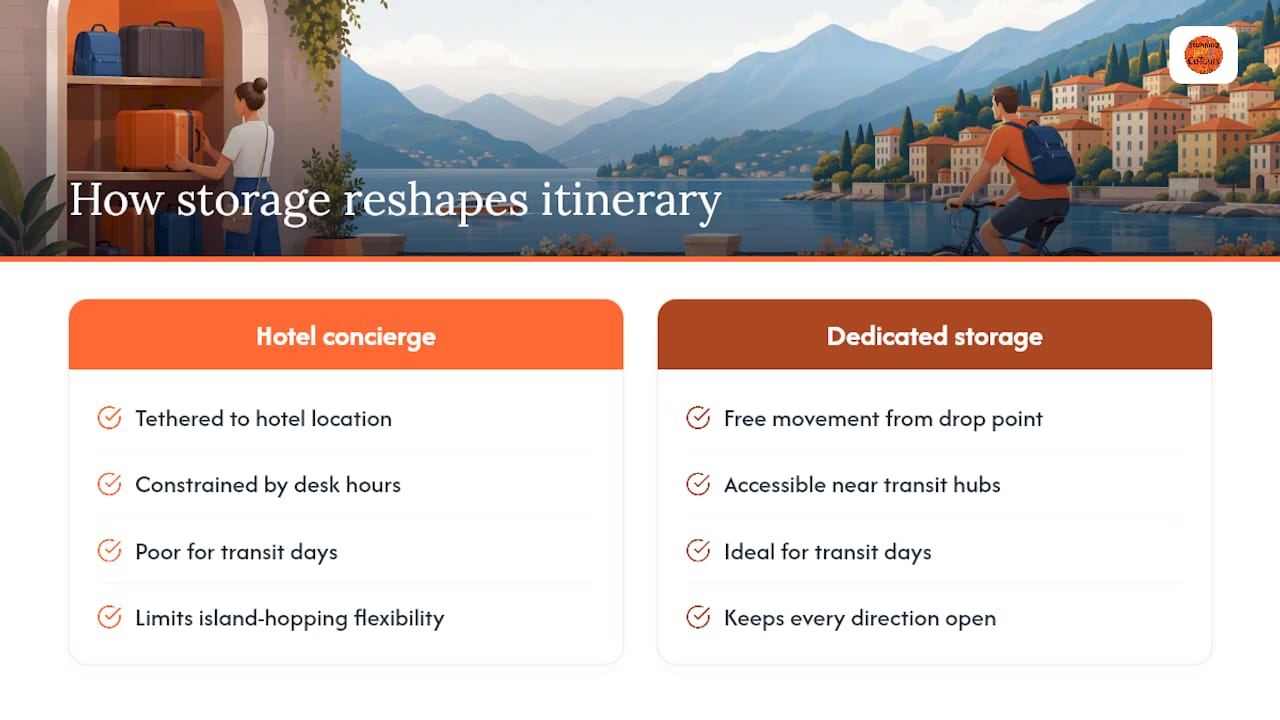
The storage decision isn’t just logistics. It determines how much of Como you actually see. Relying on hotel concierge means your movements stay tethered to that hotel’s location and desk hours, which can rule out spontaneous side trips to Bellagio or a lakefront ride if you need to be back before the desk closes.
Dedicated storage near transit hubs frees up the day. Drop a bag near Como San Giovanni or the lakefront piers in the morning, and you’re free to explore without doubling back to a specific hotel address. That matters most on transit days: arriving by train, storing bags, exploring for six hours, then catching an evening ferry or bus without ever needing a hotel room in Como at all.
The flexibility gap shows up most on multi-stop itineraries. Travelers island-hopping between Como, Bellagio, and Varenna in a single day benefit from storage that doesn’t require returning to a specific building, since a central drop-off point near the station keeps every direction open. Build your day around where your bag sits, not the other way around, and Como stops feeling like a logistics puzzle and starts feeling like the trip you planned.
If you’re a hotel guest with a short gap before your train, use the concierge. Everyone else, day-trippers, Airbnb guests, late-night arrivals, should default to dedicated storage near the station. It’s a simple rule and it holds up in nearly every situation we see.
One thing worth flagging: we’re tucked inside a hall of shops just off the main street, not right on the sidewalk, so people occasionally confuse us with Como Rental Solutions nearby, which mainly rents motorbikes and isn’t affiliated with us. Look for the large window lit up with an LED bike display, that’s how you’ll spot the right storefront.
Whatever you choose, confirm details at least 24 hours ahead. Policies shift with the season, and a two-minute call saves a stressful afternoon.
— Andrea
Skip the back-and-forth between a hotel storeroom and a locker app. Stunning Bike Co-Tours holds your bags securely near Como Lago station and puts you on a bike within minutes, so the hours you’d spend waiting turn into hours actually seeing the lake.
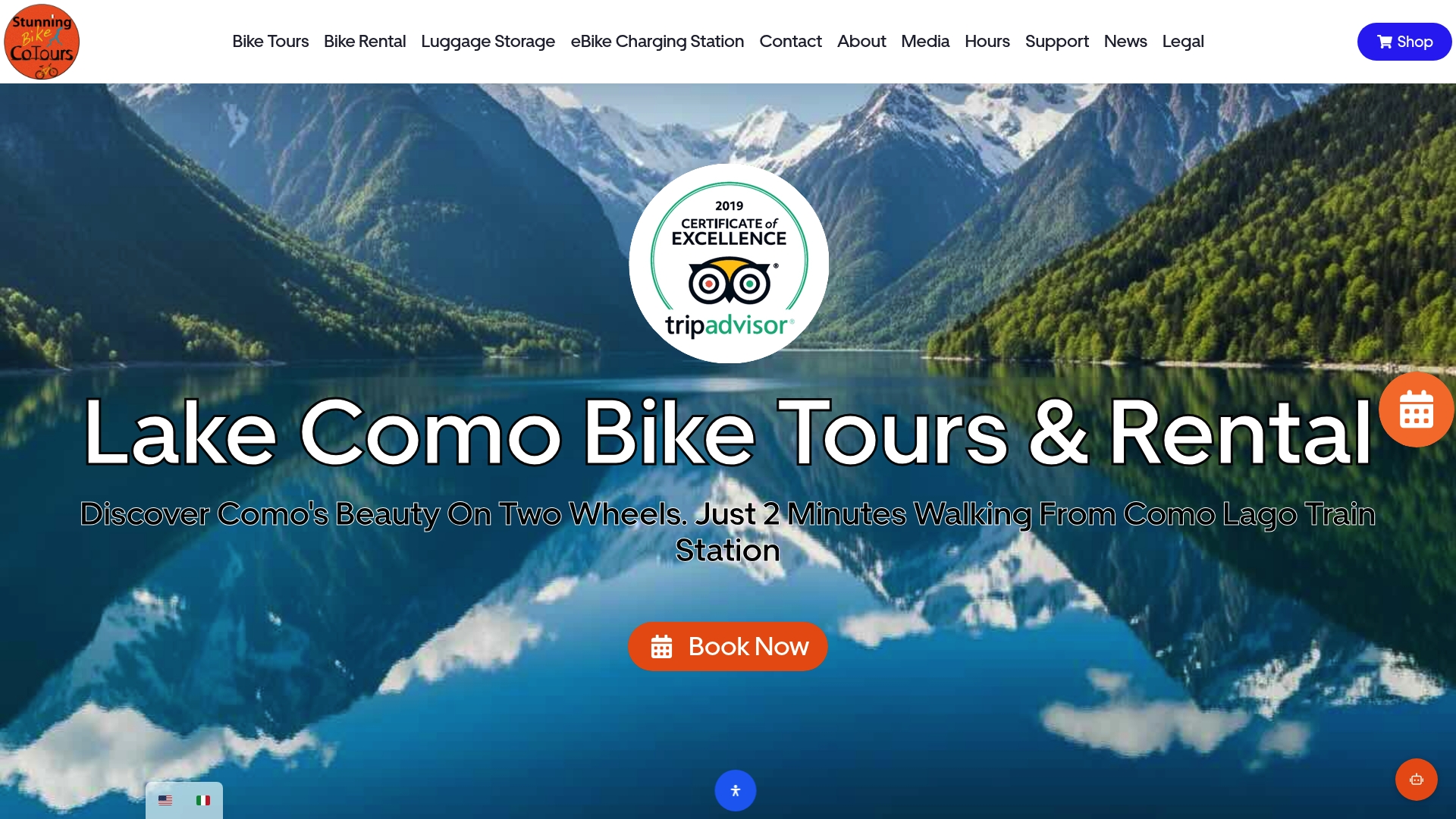
Storage is staffed, not automated, so there’s a person handling your bag rather than a locker door doing all the work. Once it’s dropped off, pick a rental or a guided tour and head out toward Villa Olmo or along the lakefront promenade with a multilingual audio guide running through your helmet. If you’re short on time and just need wheels, browse the bike rental options directly and book online before you land. Reserve your storage slot and rental together, and you’ll walk off the train straight into the best part of your day in Como.
Some hotels will store bags for non-guests as a courtesy, but many won’t, especially during busy check-in periods, so call ahead rather than assuming.
Tipping a concierge for luggage assistance is customary in many hotels but not required by any storage policy itself; it’s a courtesy for the service, not a fee for storage.
There’s no fixed rule, but a few dollars or euros per bag is a common courtesy tip when a bellman personally handles your storage and retrieval.
The same range applies as tipping a bellman: a small per-bag gratuity, typically a few dollars or euros, is standard when staff handle the physical carrying and storage of your items.
Dedicated storage providers typically publish stated insurance limits and use sealed tags or CCTV, while many hotels don’t formally insure stored bags, so ask both about coverage before deciding.